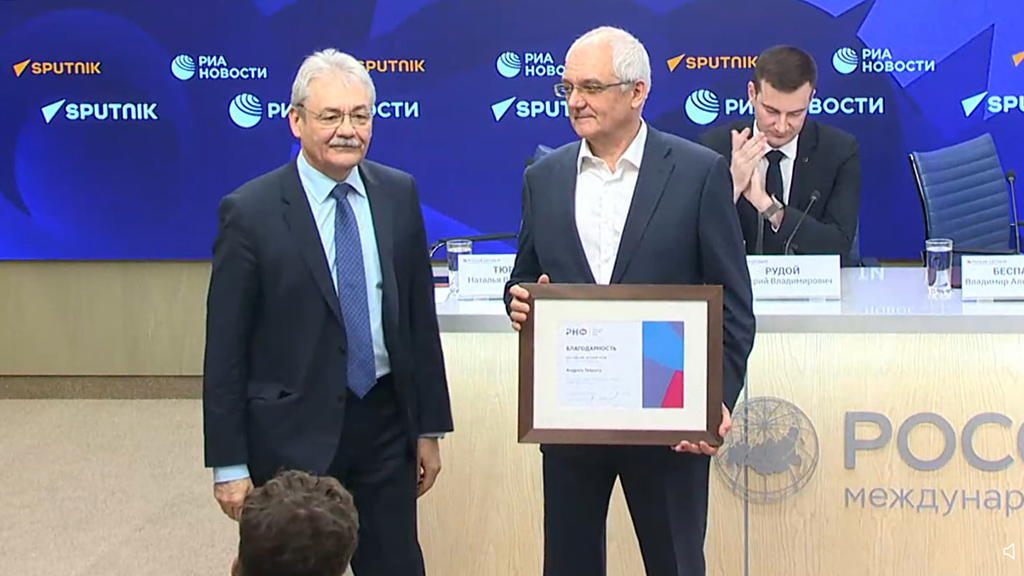
During a press conference at the Rossiya Segodnya International News Agency on December 18, 2025, the head of the Russian Science Foundation summarized the year's results, announcing the most significant scientific achievements of Russian scientists.
One such achievement was the study of the fauna of extreme depths, using the deep-sea trenches of the northwestern Pacific Ocean as an example. The project, led by the Institute of Oceanology of the Russian Academy of Sciences, was named one of the top ten discoveries of 2025 by the Russian Science Foundation.
As a result of the work, scientists discovered the deepest methane seep communities in the World Ocean, located in the Kuril-Kamchatka Trench (KKT) at a depth of 9,533 m. The discovery was made during a joint Russian-Chinese expedition using the Fendouzhe deep-sea manned vehicle (DMV) (PRC). The expedition was organized by the National Scientific Center of Marine Biology and Biology of the Far Eastern Branch of the Russian Academy of Sciences and the Institute of Deep-Sea Science and Technology of the Chinese Academy of Sciences, with the participation of the Institute of Oceanology of the Russian Academy of Sciences and the Pacific Oceanological Institute of the Far Eastern Branch of the Russian Academy of Sciences. During the research, 31 DMV dives were conducted in the KKT and the western Aleutian Trench at depths ranging from 5,537 m to 9,580 m. Methane seeps were discovered in 19 dives in the depth range of 5,800–9,533 m and in an area extending over 2,500 km.
"One of the factors contributing to the formation of methane seeps is the high primary production in this region of the northwest Pacific, resulting in a large flux of organic matter to the bottom: ~3120 gC yr-1. In this respect, the KKZh trench outperforms all other Pacific Ocean trench systems. The results obtained are crucial for understanding the limits of the distribution of chemosynthesis-based life in the ocean, as well as for assessing deep-sea carbon fluxes in the ocean," noted Andrey Gebruk, Doctor of Biological Sciences, head of the Laboratory of Oceanic Benthic Fauna at the Shirshov Institute of Oceanology, Russian Academy of Sciences, and the project leader.