


A joint team of scientists from Shirshov Institute of Oceanology of the Russian Academy of Sciences and the Kamchatka branch of VNIRO discovered that the influence of the tides must be taken into account to accurately predict the abundance of Russia's main commercial fish—pollock.
The research was conducted in the Pacific Ocean off the coast of the Kamchatka Peninsula and the northern Kuril Islands, where the main spawning areas of the East Kamchatka pollock population are located on the shelf and in deep-sea canyons.
For a long time, there was a significant gap in pollock yield forecasts: the influence of relatively short-term tidal processes was not taken into account. These abiotic factors, which directly impact the early stages of fish development (eggs and larvae), remained outside the scope of traditional research. Established methodological approaches in commercial oceanography focused on analyzing slower, seasonal, and interannual environmental dynamics and therefore did not allow for the detection and quantification of such rapidly occurring phenomena.
To address this gap, scientists undertook a large-scale study using a comprehensive, interdisciplinary approach. High-resolution computer modeling allowed them to reconstruct the complex pattern of tidal currents and underwater waves in key spawning areas. Analysis of satellite radar images over 10 years helped identify traces of 4,000 short-period internal waves on the ocean surface, the origin of which is associated primarily with tidal influence. Specialized expeditions provided field data confirming the calculations and satellite data.
It turned out that tidal currents, colliding with underwater terrain, generate giant internal waves, which, when broken up, generate trains of short-period internal waves. This process triggers a veritable chain reaction of life: a surge in nutrients triggers a phytoplankton bloom. Phytoplankton, in turn, serves as the primary food source for pollock larvae. The study not only described this relationship but also statistically confirmed it, demonstrating that increased internal disturbance on the shelf leads to an increase in pollock stocks over the years.
"These results change the traditional approach to fisheries forecasting. They demonstrate that short-term and localized phenomena, previously ignored in favor of seasonal trends, can be critical for understanding how fish stocks develop," noted Alexey Zimin, Doctor of Geographical Sciences and project leader and head of the Geophysical Boundary Layer Laboratory at St. Petersburg branch of the Institute of Oceanology of the Russian Academy of Sciences.
Tidal modeling shows localized current enhancement and strong variability in underwater terrain features.
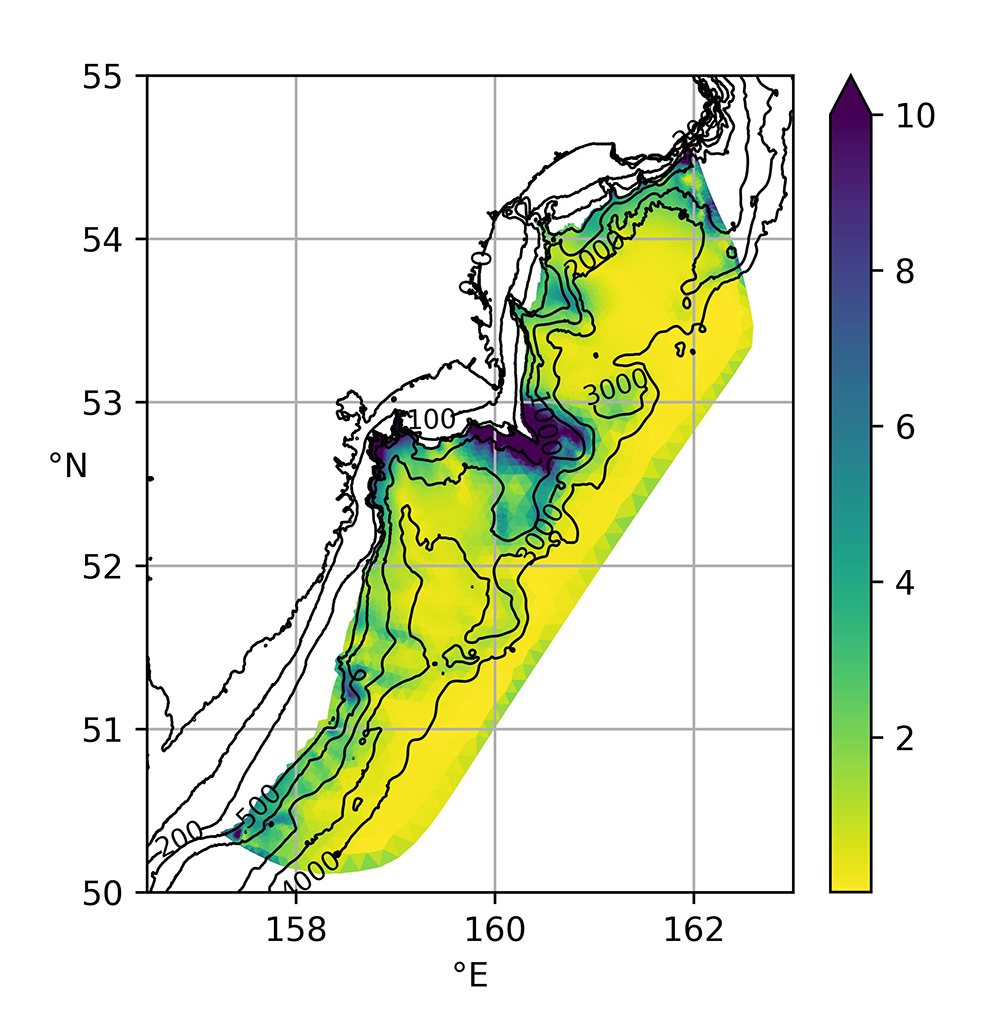 The magnitude of the internal tide fluctuations (m)
Stability in the areas of occurrence of short-period internal waves has been established, which confirms the previously proposed hypothesis of their tidal origin.
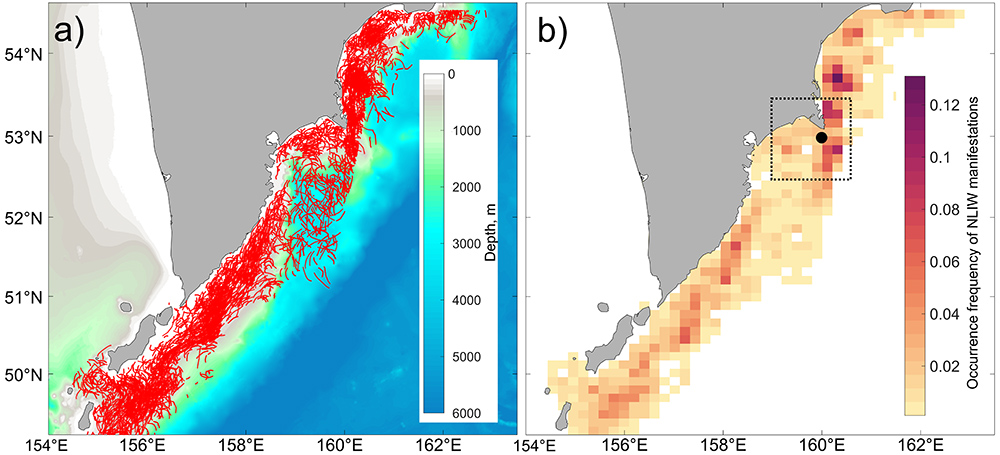 Spatial distribution of the positions of the leading ridges of the KVV manifestations (a)
and their frequency of occurrence (b)
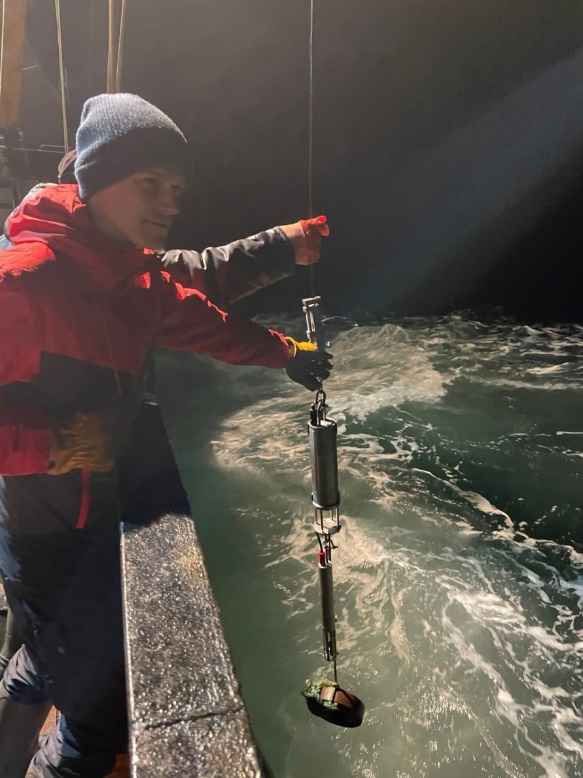 Temperature and salinity profiling STD-48
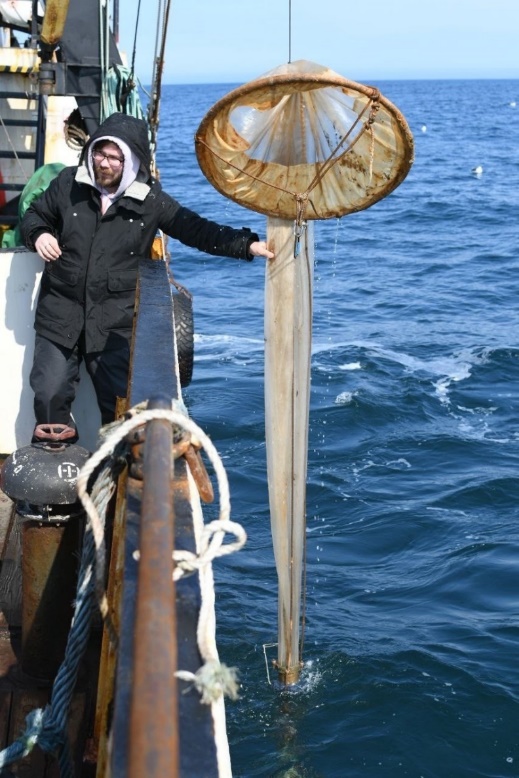 Ichthyoplankton catches with the IKS-80 net
Internal waves influence vertical mixing of water. This contributes to changes in nutrient concentrations and the distribution of planktonic organisms, which in turn affects food availability and survival for fish larvae.
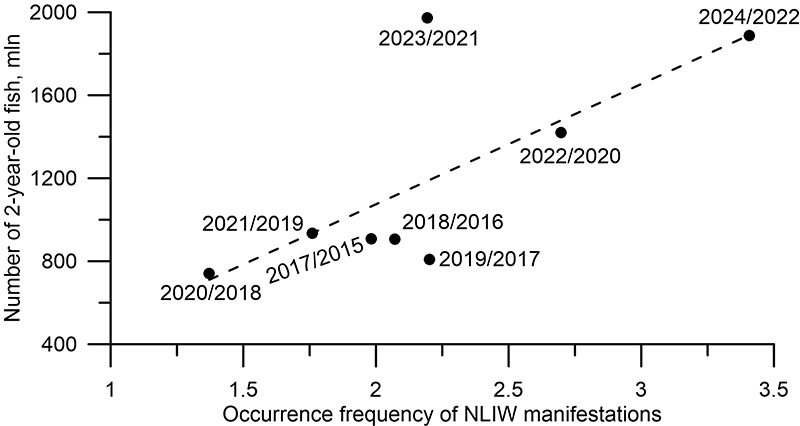 Variability by year in the abundance of two-year-old pollock specimens
and the frequency of short-period internal wave events with a two-year shift
for May–September 2017/2015 – 2024/2022
